


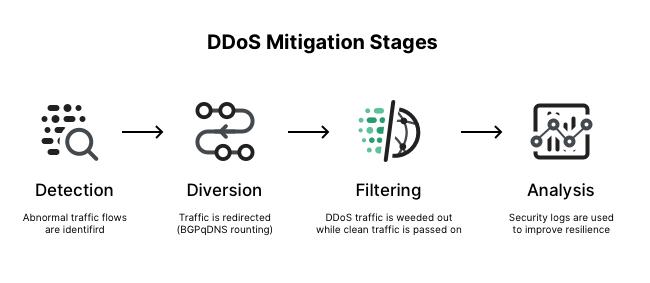
The world of denial-of-service attacks is a constantly evolving battlefield, with attackers developing new techniques and defenders responding with more sophisticated countermeasures. To understand the future of this critical cybersecurity discipline, it is essential to analyze the key DDoS Protection and Mitigation Market Trends that are shaping the next generation of defense platforms. These trends reveal a clear progression from simply blocking massive volumetric floods to a more intelligent, automated, and integrated approach that can handle a wider range of threats. The overarching theme is the use of AI and machine learning to improve detection accuracy and the convergence of DDoS protection with other application security services. These developments are making mitigation faster, more precise, and more holistic.
The single most important trend is the increasing focus on mitigating sophisticated application-layer (Layer 7) attacks. While massive volumetric attacks are still common, attackers are increasingly using more subtle, low-and-slow attacks that target specific vulnerabilities in an application, such as a login page or a search function. These attacks are much harder to detect because they can mimic legitimate user traffic. In response, a key trend is the deep integration of AI and machine learning into the mitigation platforms. These AI models are trained to learn the "normal" behavior of an application and can then spot the subtle anomalies that indicate a Layer 7 attack. This move from simple traffic-rate analysis to behavioral analysis is essential for defeating the next generation of DDoS threats.
Another powerful trend is the convergence of DDoS protection with other security services, particularly Web Application Firewall (WAF), bot management, and API security. Modern attacks are often multi-vector, combining a volumetric DDoS attack with a simultaneous attempt to exploit a software vulnerability. This has led to the rise of integrated, cloud-delivered security platforms, often called Web Application and API Protection (WAAP) or Secure Access Service Edge (SASE). Instead of buying separate point solutions for each threat, organizations are now looking for a single, unified platform that can protect them from a wide range of threats at the network edge. This trend is driving consolidation in the market and forcing pure-play DDoS vendors to either broaden their offerings or partner with other security providers.
Finally, a critical trend is the push for greater automation and faster time-to-mitigation. In the past, detecting and mitigating a DDoS attack often required manual intervention from a security analyst. The modern trend is towards "always-on," fully automated mitigation. For cloud-based services, this means that traffic is constantly being monitored, and mitigation is triggered automatically within seconds of an attack being detected, without any human involvement. This dramatically reduces the time to mitigation and minimizes the impact of an attack. This is being further enhanced by the use of AI to automatically generate custom mitigation rules for new and unknown "zero-day" attack vectors, creating a more adaptive and self-learning defense system. The future of DDoS mitigation is one where protection is instant, intelligent, and invisible.
Top Trending Reports:

 English
 Arabic
 French
 Spanish
 Portuguese
 Deutsch
 Dutch
Dutch
 Italiano
 Russian
 Romaian
 Portuguese (Brazil)
 Tiếng Việt